
MOTOR COACH INSURANCE GUIDE
Charter Business Transportation Insurance Solutions Since 1981
Understanding Insurance Protection for Professional Charter Bus & Ground Transportation Companies
Operating a professional motor coach, charter bus, or passenger transportation company comes with significant responsibility. Your business is entrusted with transporting groups of passengers safely while managing expensive commercial vehicles, professional drivers, demanding schedules, regulatory requirements, and substantial liability exposures.
This Motor Coach Bus Insurance Guide provides an overview of important insurance considerations for charter bus, motor coach, shuttle, tour, and professional ground transportation companies. We’ll explore the essential Motor Coach Bus Business Transportation Insurance Solutions professional charter bus and ground transportation companies should consider when protecting their operations.
We’ll cover key insurance options, liability considerations, fleet and driver risks, and important state and federal safety and insurance regulations that may affect your business. You’ll also learn how Professional Insurance Center (PIC) can help evaluate your operation, compare available coverage options, and build an insurance program tailored to your motor coach fleet.
Ready to Compare MOTOR COACH Insurance Rates?
What Is Motor Coach Transportation Insurance?
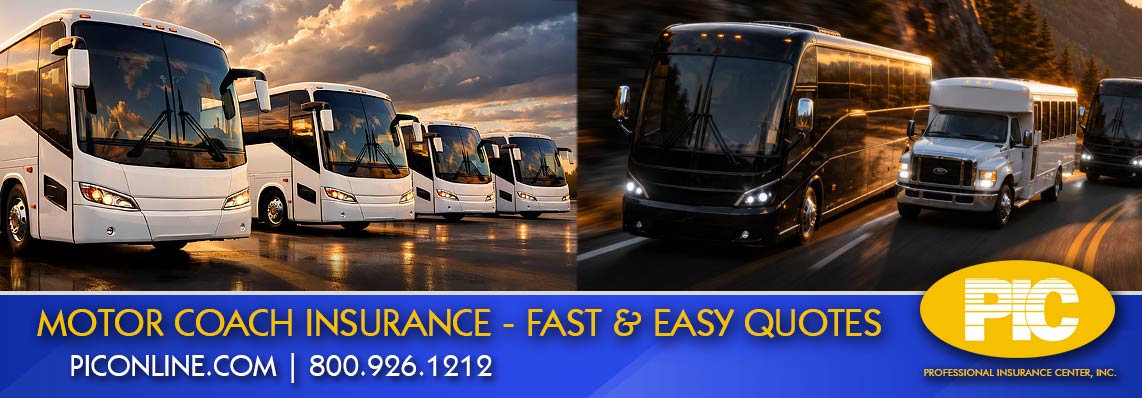
Motor coach transportation insurance is specialized commercial insurance designed for businesses that transport passengers for compensation. Unlike a standard commercial auto operation, motor coach and charter bus companies can face significant passenger liability exposures because a single vehicle may transport dozens of passengers at one time.
Motor coach insurance programs may be appropriate for businesses operating:
- Motor coaches
- Charter buses
- Tour buses
- Executive coach buses
- Shuttle buses
- Minibuses
- Executive passenger buses
- Employee transportation buses
- Airport transportation buses
- Hotel and resort shuttles
- Convention transportation vehicles
- School and private-school transportation vehicles
- Church buses
- Sprinter passenger vans
- Group transportation fleets
The appropriate insurance program depends on factors such as vehicle seating capacity, operating territory, whether transportation crosses state lines, the services provided, driver qualifications, contracts, and applicable state and federal regulations.
PIC works with a variety of professional ground transportation businesses, including charter bus companies, motor coach operators, limousine companies, executive transportation providers, tour operators, shuttle companies, airport transportation providers, corporate transportation companies, hotel shuttle operators, and other passenger transportation fleets.
Your insurance requirements can vary considerably depending upon how your company operates. For example, a local shuttle company operating exclusively within one state may face different requirements than an interstate charter bus company transporting passengers throughout multiple states. Understanding these differences is an important part of developing the right insurance program.
Understanding State & Federal Motor Coach Safety and Insurance Regulations
Motor coach operators should understand that insurance requirements and transportation safety regulations are related, but they are not necessarily the same thing.
A transportation company may need to comply with federal regulations, state regulations, local licensing requirements, contractual insurance requirements, or a combination of these standards.
Interstate passenger transportation companies may fall under the jurisdiction of the Federal Motor Carrier Safety Administration (FMCSA) and applicable Federal Motor Carrier Safety Regulations.
Interstate motor coach companies generally must obtain USDOT registration and, when applicable, federal operating authority before transporting passengers for compensation in interstate commerce. Certain exemptions can apply depending on the operation.
This is why transportation businesses should evaluate more than simply the price of an insurance policy. Your insurance program should be reviewed in relation to your vehicles, passenger capacities, operating authority, operating territory, contracts, and regulatory responsibilities.
Federal Passenger Carrier Insurance Requirements
Under current federal financial-responsibility rules, for-hire passenger carriers operating in interstate or foreign commerce are generally subject to minimum public-liability requirements based on vehicle seating capacity.
For vehicles designed to transport 16 or more passengers, including the driver, the federal minimum is generally $5 million.
For vehicles designed to transport 15 or fewer passengers, including the driver, the federal minimum is generally $1.5 million.
Importantly, federal guidance indicates that the required level can be determined by the highest seating capacity of a vehicle within the interstate for-hire passenger carrier's fleet.
Exceptions and special circumstances can apply, which is why operators should verify the regulations applicable to their particular business.
Federal Motor Coach Insurance Filings
For passenger carriers that require FMCSA operating authority, having an insurance policy alone may not complete the federal insurance process.
FMCSA requires applicable proof of financial responsibility to be filed in connection with operating authority. FMCSA states that operating authority will not be granted until the required minimum financial responsibility is in effect and properly filed. Carriers must continue maintaining required filings to avoid potential revocation proceedings.
PIC can help operators understand the insurance side of these requirements and work with the appropriate insurance carrier regarding required filings.
State Motor Coach Insurance Requirements
Federal regulations are only part of the picture. Motor coach and passenger transportation companies can also be subject to state insurance requirements, state transportation regulations, public utility or transportation commission requirements, airport regulations, municipal requirements, and contractual insurance standards.
Requirements may differ based upon:
- State of operation
- Interstate versus intrastate operations
- Passenger capacity
- Vehicle classification
- For-hire status
- Type of passenger service
- Operating authority
- Airport operations
- School or student transportation
- Government transportation contracts
- Corporate transportation contracts
A business operating in several states should be especially careful when evaluating its insurance program.
PIC can help you evaluate your operation and available insurance options; however, transportation companies should independently verify current federal, state, and local regulatory requirements with the appropriate regulatory authorities.
Important Motor Coach Bus Insurance Coverages
A comprehensive motor coach insurance program may involve several different forms of commercial insurance protection:
Commercial Auto Liability Insurance
Commercial auto liability is one of the most important components of a motor coach insurance program. It can provide protection when an insured vehicle is involved in a covered accident resulting in bodily injury or property damage for which the transportation company is legally responsible. Because motor coaches can transport large numbers of passengers, liability limits are an especially important consideration for charter and passenger transportation companies.
Physical Damage Coverage for Your Motor Coach Fleet
Motor coaches, executive buses, and specialty passenger transportation vehicles represent a substantial investment. Physical damage insurance can help protect covered vehicles against losses resulting from covered events such as collisions, theft, vandalism, fire, and other covered causes of loss, subject to the policy's terms, conditions, exclusions, and deductibles.
PIC can help operators evaluate coverage options based on the type and value of vehicles within their fleet.
General Liability Insurance
Commercial General Liability Insurance can provide important protection for exposures that may fall outside the operation of your insured vehicles. Depending on the policy and operation, this may include certain premises, business operations, and other non-auto liability exposures.
A transportation insurance specialist can help determine how general liability coverage should work alongside your commercial auto insurance.
Workers' Compensation Insurance
Motor coach companies depend on professional drivers, dispatchers, mechanics, administrative employees, and other team members. Workers' Compensation insurance can provide important benefits for employees who experience covered work-related injuries or illnesses while also helping employers satisfy applicable workers' compensation requirements. For larger transportation companies, Workers' Compensation should be evaluated as part of the company's overall risk-management program rather than separately from its transportation insurance.
Umbrella & Excess Liability Insurance
Some transportation businesses may need liability limits beyond those provided by their underlying policies. Corporate clients, government agencies, venues, airports, universities, hotels, tour operators, or other contracting organizations may require higher insurance limits as a condition of doing business. Commercial Umbrella or Excess Liability insurance may provide additional limits above certain underlying policies, subject to policy terms and conditions. PIC also offers Cyber Insurnace Coverage.
PIC can help evaluate available options when your operation requires additional liability protection.
FREE INSURANCE QUOTE
Trusted Ground Transportation Insurance Solutions Since 1981
Understanding Motor Coach Contractual Insurance Requirements
Insurance requirements are not always established by government regulations. Your customers and business partners may establish their own insurance requirements. A charter bus company could encounter insurance specifications when working with:
- Corporations
- Universities and colleges
- Schools
- Hotels and resorts
- Airports
- Convention centers
- Destination management companies
- Travel agencies
- Tour operators
- Government agencies
- Sports organizations
- Event planners
- Large corporate accounts
These contracts may require specific liability limits, certificates of insurance, additional insured status, or other insurance provisions. Before signing a major transportation contract, operators should review the insurance requirements carefully and confirm that the requested coverage is available under their insurance program.
Coach Bus Driver/Chauffeurs Qualifications Matter
Your drivers are among the most important components of your transportation operation—and they can also have a major impact on your company's risk profile and insurance program. Federal and state regulations may establish driver qualification standards for certain passenger transportation operations. FMCSA maintains specific guidance addressing passenger-carrier safety regulations and driver qualifications. Insurance carriers may also evaluate factors such as:
- Driver age and experience
- Commercial driver's license requirements
- Driving history
- Motor vehicle records
- Passenger transportation experience
- Accident history
- Driver training
- Safety procedures
- Hiring practices
- Ongoing driver monitoring
Establishing strong hiring, screening, training, and safety procedures can help create a stronger overall risk profile.
Motor Coach Bus Fleet Safety & Risk Management
Insurance should be only one component of your company's overall risk-management strategy.
Professional motor coach operators should maintain strong safety procedures designed to reduce accidents, protect passengers, and identify potential problems before they become costly losses.
An effective safety program may include driver screening, regular motor vehicle record reviews, vehicle inspections, preventive maintenance programs, documented driver training, accident-response procedures, distracted-driving policies, hours-of-service compliance where applicable, electronic logging compliance where required, and ongoing management oversight.
A strong safety culture can help protect passengers while demonstrating to insurance carriers that your organization takes risk management seriously.
Why Motor Coach Insurance Costs Vary
There is no universal price for motor coach insurance. Insurance carriers evaluate many characteristics of a transportation company before determining eligibility, coverage options, and premiums.
Factors may include:
-
Fleet Size & Vehicle Type
The number, type, passenger capacity, age, and value of your vehicles can affect insurance costs.
-
Operating Territory
Local, regional, interstate, and nationwide transportation operations may present different risk characteristics.
-
Annual Mileage
The amount of time your vehicles spend on the road can influence overall exposure.
-
Driver Experience
Driver qualifications, experience, age, licensing, and driving records may affect underwriting.
-
Loss History
Previous accidents and insurance claims can significantly affect premiums and carrier eligibility.
-
Type of Transportation
Charter transportation, tours, airport transportation, employee shuttles, and other services can present different underwriting considerations.
-
Passenger Capacity
Larger passenger capacities can create greater potential liability exposure.
-
Insurance Limits
Higher liability limits and broader coverage generally affect overall insurance costs.
FAQs About CHARTER Motor Coach TRANSPORTATION Insurance:
How much liability insurance does a motor coach company need?
The answer depends on your operation and applicable regulations. For-hire passenger carriers subject to federal interstate financial-responsibility requirements generally face a $5 million minimum for vehicles designed to transport 16 or more passengers, including the driver, and $1.5 million for vehicles designed for 15 or fewer, including the driver. Exceptions can apply.
State regulations and contractual requirements may require additional consideration.
Does every charter bus company need $5 million in liability insurance?
Not necessarily. Requirements depend upon factors including interstate or intrastate operations, passenger capacity, regulatory status, exemptions, state law, and contractual obligations. Operators should verify the requirements applicable to their individual operation.
Do interstate charter bus companies need FMCSA operating authority?
Interstate for-hire passenger carriers generally must obtain applicable FMCSA registration and operating authority before transporting passengers for compensation, although certain statutory exemptions exist.
Can one insurance policy cover multiple motor coaches?
Transportation insurance programs can generally be structured to insure fleets containing multiple scheduled vehicles, subject to carrier underwriting and policy terms. PIC can help evaluate coverage for fleets ranging from smaller operations to larger transportation companies.
Can PIC insure other vehicles in our transportation fleet?
Depending on carrier availability and underwriting requirements, PIC can help explore insurance options for mixed transportation fleets that may include motor coaches, charter buses, minibuses, shuttle buses, Sprinter vans, executive sedans, SUVs, limousines, and other passenger transportation vehicles.
Can PIC help with interstate motor coach operations?
Yes. PIC works with professional ground transportation businesses and can help evaluate available insurance solutions based on the company's operating territory, fleet, passenger capacity, drivers, and transportation services.
The Benefits of Working with Professional Insurance Center
Choosing Professional Insurance Center means working with an experienced insurance team that understands the specialized needs of the motor coach and charter transportation industry. As an independent insurance agency, PIC has access to multiple highly rated insurance carriers and specialized transportation insurance markets. This allows us to shop and compare multiple coverage options and competitive rates on your behalf.
PIC also provides the personalized service and ground transportation industry knowledge transportation professionals need in a constantly changing insurance marketplace. Our team can help you understand coverage options, insurance requirements, policy changes, and important considerations as your fleet and business grow. From your initial quote to ongoing policy service and claims assistance, we're here to help keep your transportation operation protected and moving forward.
Compare multiple options, and discover why transportation professionals trust PIC for their Motor Coach Bus Fleet Insurance needs.
PIC offers all you need to get the comprehensive insurance.
Contact us today and experience the Professional Insurance Center difference.
Associations
We are very proud to be a part of these great associations.
Award-Winning Service for over 40+ Years.